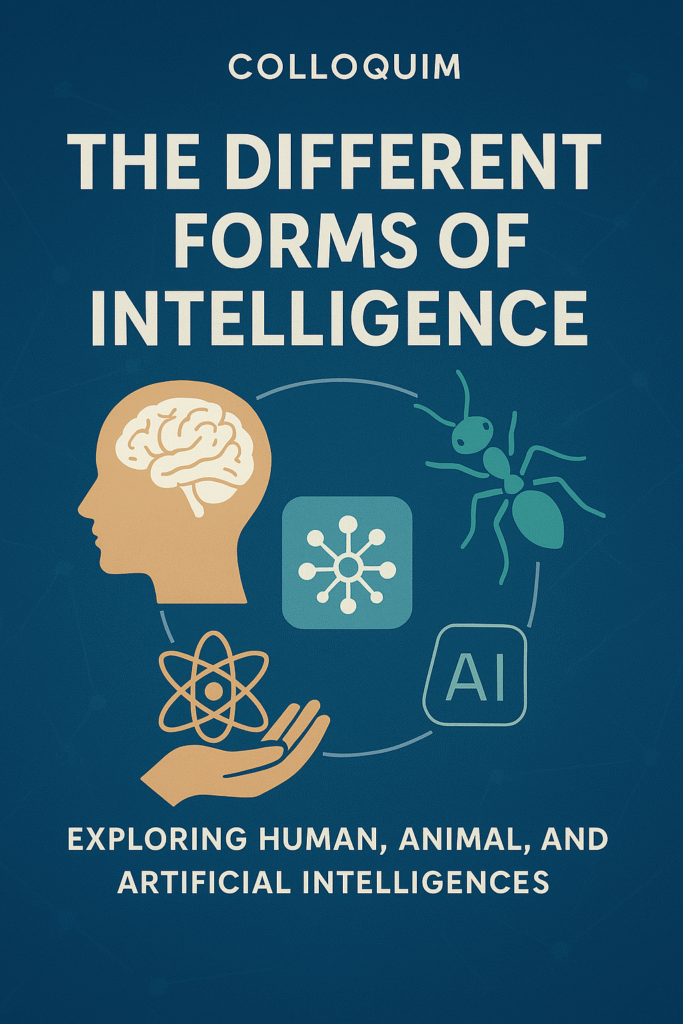
2026 Colloquium “IntelligenceS: Brains, collectives, and machines”
Welcome to this exceptional symposium dedicated to exploring the many forms of intelligence that shape our understanding of the world and influence our lives. Today, we will broaden our vision of what intelligence is, addressing not only human intelligence, but also that of other species and emerging technologies.
Intelligence, long reduced to the simple measurement of the intelligence quotient, is now viewed through a much broader lens. Beyond logic and traditional cognitive skills, we will explore:
- Collective intelligence, as observed in animal societies such as ants, where intelligence emerges not from an individual but from cooperation and interaction among thousands of agents. How can such decentralized systems solve complex problems without any single member possessing individual consciousness?
- Human intelligence, with its many forms — rational, emotional, creative, social, and more. Recent advances in psychology and neuroscience show that human intelligence extends beyond abstract thinking to include adaptability, empathy, and cooperation.
- Manipulated intelligence, a fascinating and sometimes controversial field in which scientists attempt to modify or interfere with neural circuits to study specific behaviors. For example, by introducing or removing memory engrams in mice, researchers explore the brain’s plasticity and learning capabilities — and question the very nature of memory and intelligence itself.
- Artificial intelligence (AI), a rapidly expanding domain that, through machine learning and increasingly sophisticated algorithms, seeks to imitate certain functions of human intelligence. What role will AI play in our society? Could it one day possess a form of intelligence comparable to our own?
- Philosophical intelligence, finally, offers a more abstract and existential reflection on what intelligence truly is. From Plato to Kant and modern thinkers, philosophers have long pondered this essential question: is intelligence purely functional, or is it a reflection of our consciousness — our capacity to understand and give meaning to the universe around us?
Throughout this week, we will have the opportunity to hear from researchers, scientists, and experts who will shed light on these diverse aspects of intelligence, while inviting us to reflect on what these forms of knowledge and ability teach us about our own place in the world.
We encourage you to participate actively in discussions, challenge assumptions, and together imagine a future where human, animal, and artificial intelligences coexist and interact in new and unprecedented ways.